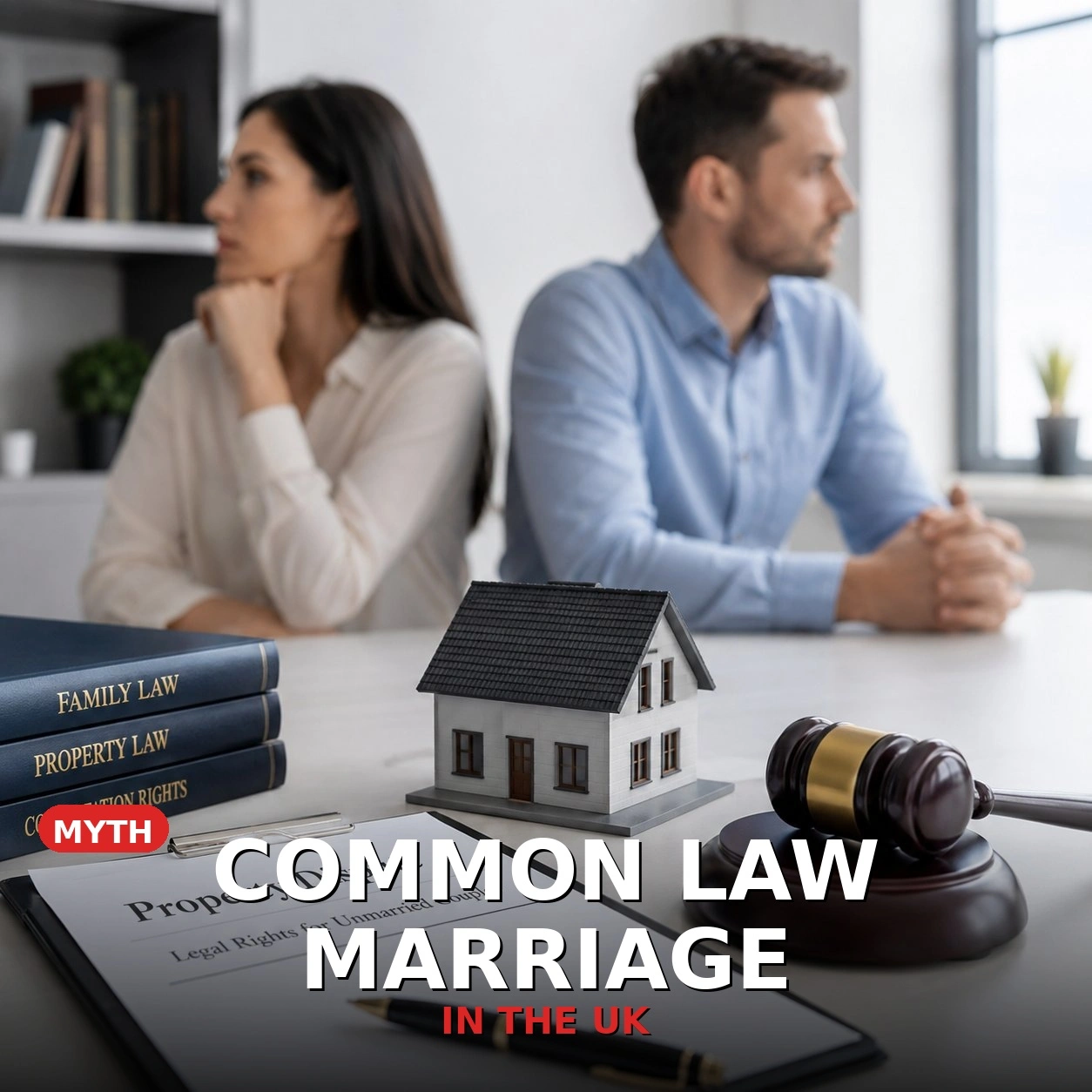
Common Law Marriage - Cohabitation Law IN UK
One of the biggest myths in UK family law is that living together gives you the same rights as marriage.
It doesn’t.
Thousands of unmarried couples separate every year believing they are in a “common law marriage” — only to discover that the law treats them very differently from married couples. In England and Wales, there is no such legal status as a common law husband or wife.
So, can your ex claim your house if you were never married?
The answer is:
Sometimes — but not automatically.
It depends on:
- whose name is on the property,
- whether your ex contributed financially,
- what was agreed between you,
- and whether they can prove a “beneficial interest” in the home.
Here’s what unmarried couples in the UK need to know before a breakup turns into a property dispute.
Do Unmarried Couples Have Rights to Property in the UK?
Unlike divorce cases, there is no automatic legal process that splits assets “fairly” when unmarried couples separate.
If you are not married or in a civil partnership:
- your ex does NOT automatically get half your house,
- they do NOT automatically get maintenance,
- and living together for years does NOT create marriage-like rights.
However, your ex MAY still be able to claim an interest in the property under property and trust law.
This is where disputes become expensive.
The Biggest Myth: “Common Law Marriage”
Many people believe:
- living together for years,
- having children,
- or calling each other husband and wife
creates legal rights over property.
That belief is wrong.
UK courts repeatedly confirm that “common law marriage” has no legal meaning in England and Wales.
Even if:
- you lived together for 20 years,
- shared bills,
- or raised children together,
your ex still may have no automatic ownership rights over your house.
When CAN an Ex Claim Your House?
Your ex may be able to make a claim if they can prove they have a legal or beneficial interest in the property.
This usually happens under a law called:
TOLATA
The Trusts of Land and Appointment of Trustees Act 1996 (TOLATA) governs property disputes between unmarried couples.
A TOLATA claim can arise where:
- one partner contributed to the deposit,
- paid towards the mortgage,
- funded renovations,
- or there was a shared understanding they would own part of the property.
Situation 1: The House Is Only in Your Name
If the property is solely in your name, the starting position is:
You own the house.
But that does NOT always end the matter.
Your ex could still argue they gained a beneficial interest through:
- mortgage contributions,
- major renovation payments,
- direct financial investment,
- or promises made during the relationship.
Example:
- You bought the house before the relationship.
- Your partner later paid toward the mortgage for years.
- They paid £30,000 for an extension.
- You told them “this is our forever home.”
That could potentially support a TOLATA claim.
Situation 2: You Bought the House Together
If both names are on the deeds, ownership becomes much more complicated.
The court will examine:
- how the property was legally owned,
- financial contributions,
- declarations of trust,
- and the intentions of both parties.
Without a written agreement, disputes can quickly become expensive litigation.
What Counts as a “Contribution”?
Not all payments create ownership rights.
Generally, stronger evidence includes:
- deposit contributions,
- mortgage payments,
- paying for structural renovations,
- funding major improvements.
Weaker claims include:
- groceries,
- utility bills,
- general living expenses,
- childcare alone.
Reddit discussions from UK legal forums repeatedly show confusion around this issue, especially where one partner contributes to bills but not the mortgage.
Can My Ex Force Me to Sell the House?
Potentially, yes.
Under TOLATA, courts can:
- determine ownership shares,
- order the sale of the property,
- or decide who can live there temporarily.
This is why unmarried property disputes can become highly stressful and expensive.
Does Having Children Change Things?
Children can affect:
- housing arrangements,
- financial support,
- and court decisions regarding occupation.
However:
- having children together does NOT automatically give your ex ownership of your house.
Separate claims involving children may arise under Schedule 1 of the Children Act 1989.
How to Protect Yourself Before Moving In Together
The safest option is to document everything before problems arise.
1. Cohabitation Agreement
A cohabitation agreement can clarify:
- who owns what,
- how bills are paid,
- and what happens if you separate.
Requests for these agreements are increasing significantly in the UK.
2. Declaration of Trust
This records:
- deposit contributions,
- ownership percentages,
- and how sale proceeds should be divided.
Legal experts increasingly warn unmarried couples to use declarations of trust when buying property together.
3. Keep Financial Records
Save:
- bank transfers,
- mortgage payments,
- renovation invoices,
- and written agreements.
These can become critical evidence in disputes.
Are UK Laws Changing for Unmarried Couples?
Pressure is growing for reform.
Recent reports show increasing calls for stronger rights for cohabiting couples, as more than 3.5 million UK couples now live together unmarried.
However, as of 2026:
- unmarried couples still do NOT have the same protections as married couples.
How Adam Bernard Solicitors Can Help
If you are separating from an unmarried partner and worried about property rights, Adam Bernard Solicitors can provide legal advice on:
- TOLATA claims,
- beneficial interest disputes,
- cohabitation agreements,
- declarations of trust,
- jointly owned property disputes,
- and unmarried couples’ rights in England and Wales.
Their family and property law teams assist clients with resolving disputes involving:
- ownership of the family home,
- forcing the sale of property,
- protecting financial contributions,
- and defending claims made by former partners.