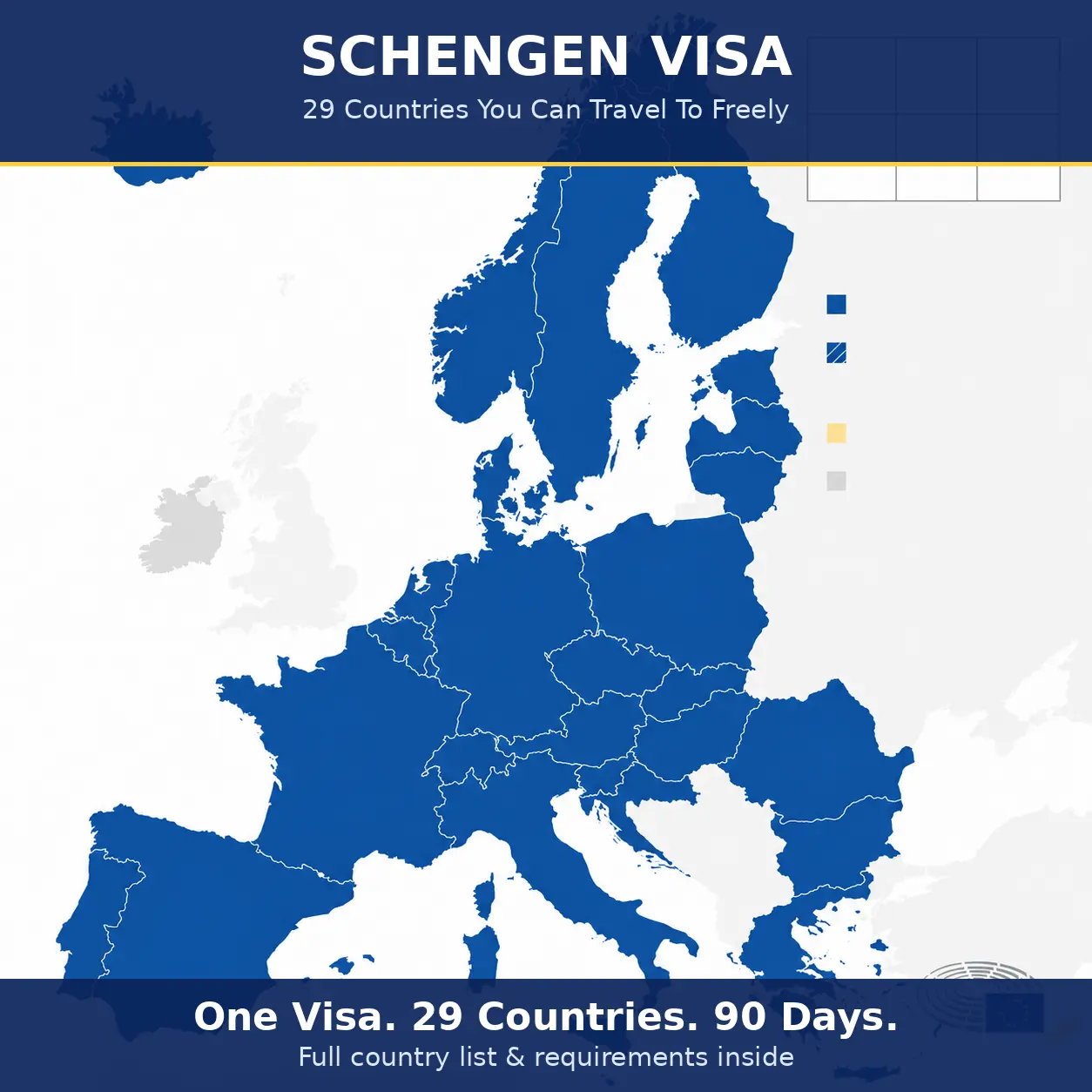
Quick answer: A single Schengen visa lets you travel visa-free to 29 European countries — 25 EU member states plus Iceland, Norway, Liechtenstein, and Switzerland. Once you enter any one of these countries, you can move freely across all the others for up to 90 days within any 180-day period, with no extra border checks or extra visas required.
This guide gives you the complete, up-to-date list of every country you can visit on a Schengen visa, which popular European destinations are not included (Cyprus, Ireland, the UK, and the Western Balkans), and answers to the questions travelers ask most.
What Is a Schengen Visa?
A Schengen visa is a single short-stay visa issued by any of the Schengen member states that grants entry to the entire Schengen Area — not just the country that issued it. It was created under the 1985 Schengen Agreement, which abolished passport checks at the internal borders between member countries. For visa purposes, the Schengen Area functions as one combined territory, so your 90-day allowance is shared across all 29 countries, not counted separately per country.
Full List of 29 Schengen Countries You Can Travel To
EU Member States in the Schengen Area (25)
# | Country | |
1 | Austria | |
2 | Belgium | |
3 | Bulgaria | |
4 | Croatia | |
5 | Czechia (Czech Republic) | |
6 | Denmark | |
7 | Estonia | |
8 | Finland | |
9 | France | |
10 | Germany | |
11 | Greece | |
12 | Hungary | |
13 | Italy | |
14 | Latvia | |
15 | Lithuania | |
16 | Luxembourg | |
17 | Malta | |
18 | Netherlands | |
19 | Poland | |
20 | Portugal | |
21 | Romania | |
22 | Slovakia | |
23 | Slovenia | |
24 | Spain | |
25 | Sweden |
Non-EU Countries in the Schengen Area (4)
# | Country |
26 | Iceland |
27 | Liechtenstein |
28 | Norway |
29 | Switzerland |
Bonus territories: A Schengen visa also covers Spain’s Canary Islands and the Portuguese/Spanish Atlantic islands (Madeira, Azores), since these are part of the issuing Schengen state.
Recent changes worth knowing: Croatia became a full Schengen member in 2023. Bulgaria and Romania joined by air and sea in March 2024 and completed full land-border integration on 1 January 2025 — so both now function as complete Schengen members with no internal border checks.
Countries That Are Often Confused With Schengen — But Are NOT Included
A Schengen visa does not grant entry to these popular European destinations:
- Cyprus – An EU member, but not yet in the Schengen Area (accession is pending). You need a separate Cyprus visa or, in some cases, a Cyprus “pro-visa” if you already hold a valid Schengen visa — rules vary, so check with the Cypriot consulate.
- Ireland – EU member with a permanent Schengen opt-out; it runs its own visa system under the Common Travel Area with the UK.
- United Kingdom – Never part of Schengen, even while an EU member; has its own separate visa/ETA system.
- Western Balkans – Albania, Bosnia and Herzegovina, Kosovo, Montenegro, North Macedonia, and Serbia are outside both the EU and Schengen (though several accept Schengen visa holders visa-free or on arrival under their own national rules).
- Georgia, Moldova, Ukraine, Turkey – Independent, non-Schengen visa systems.
If your trip includes any of these, check that country’s own entry requirements separately — a Schengen visa alone will not get you in.
The 90/180-Day Rule, Explained
This is the rule that trips up the most travelers:
- You can stay in the Schengen Area for a maximum of 90 days within any rolling 180-day period.
- The 90 days are cumulative across all 29 countries combined — two weeks in France, three weeks in Italy, and a month in Spain all draw from the same 90-day pool.
- The 180-day window is rolling, not fixed to a calendar — it recalculates from whichever day you’re checking, looking back 180 days.
- Since 2026, most Schengen borders use the Entry/Exit System (EES), a biometric system replacing manual passport stamps, which automatically tracks your days in the zone. ETIAS (a pre-travel authorization for visa-exempt travelers) is also rolling out for eligible nationalities.