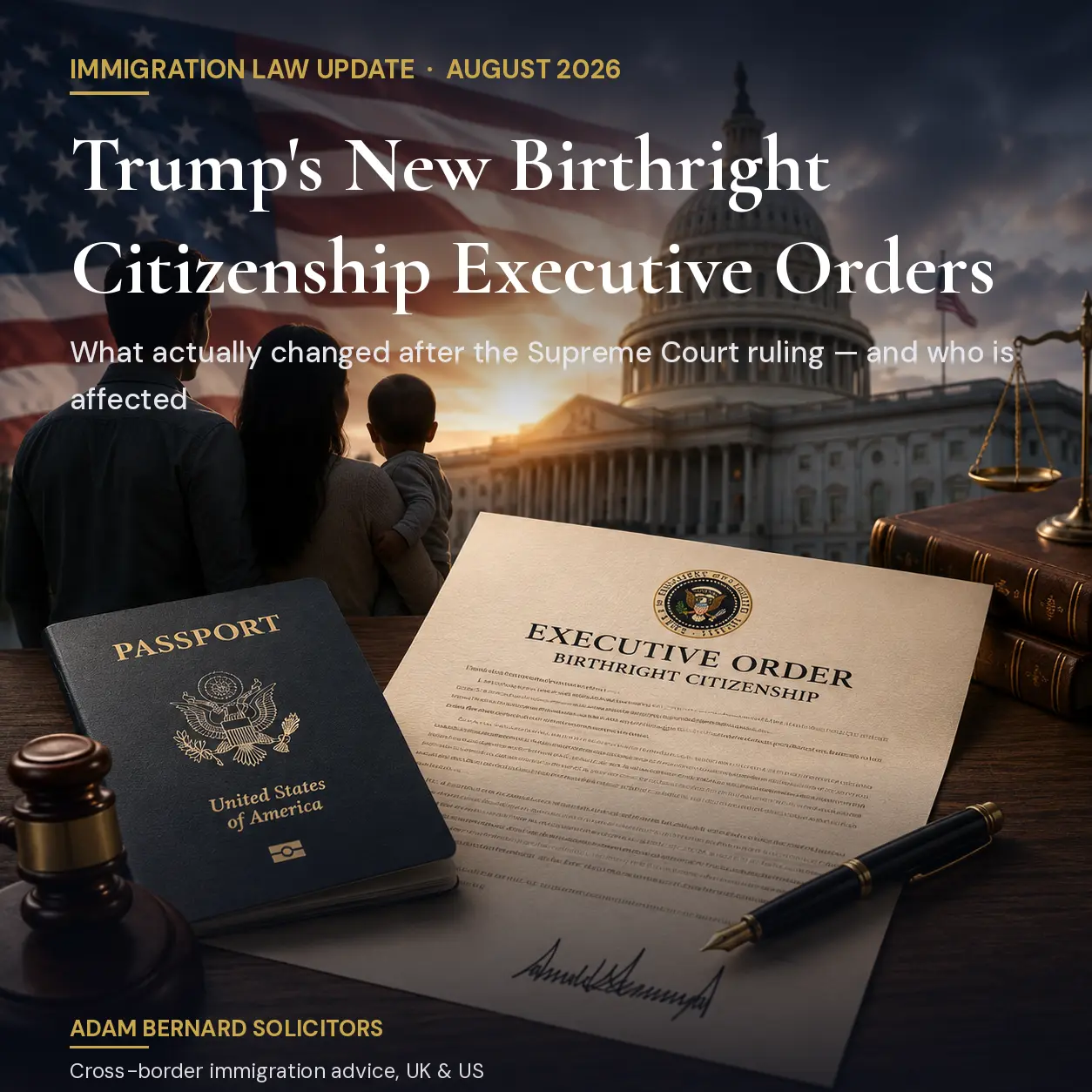
On 6 August 2026, President Trump signed two new executive orders restricting birthright citizenship, five weeks after the US Supreme Court struck down his original attempt as unconstitutional. The new orders are narrower than the first, targeting specific categories of children rather than the broad population of babies born to non-citizen parents, but they are already facing legal challenges and have not changed the underlying law for the vast majority of families.
For UK-based families with US ties, cross-border couples, and anyone planning a birth in the United States, understanding exactly what has and hasn’t changed is essential before making any assumptions about a child’s citizenship status.
What the Supreme Court decided in June 2026
On 30 June 2026, the Supreme Court ruled in Trump v. Barbara that the Fourteenth Amendment’s Citizenship Clause guarantees citizenship to nearly all children born on US soil, regardless of their parents’ immigration status. The ruling struck down Trump’s original 20 January 2025 executive order, which had attempted to deny automatic citizenship to babies born in the US without at least one citizen or lawful permanent resident parent.
The Court held that the Citizenship Clause establishes a broad, territorial rule of citizenship, subject only to a narrow set of historic exceptions — chiefly children of foreign diplomats and children born to hostile occupying forces. That ruling remains the law of the land today.
What the new executive orders actually do
Rather than trying again to override the Fourteenth Amendment outright, the administration’s two new orders — signed 6 August 2026 — attempt to work within the narrow exceptions the Supreme Court itself recognised.
Order one: “Continuing to Protect the Meaning and Value of American Citizenship.” This order instructs federal agencies not to recognise citizenship documents for a child when neither parent is a US citizen and one of several conditions applies, including where a parent is classed as an “alien enemy” — defined to include members of a designated Foreign Terrorist Organisation or a Specially Designated Global Terrorist. It also targets children of some foreign diplomatic staff, and signals a possible future extension to children born in certain US territories.
Order two: the “birth tourism” order. This delegates authority to the Secretaries of State and Homeland Security to clamp down on commercial “birth tourism” — the practice of travelling to the US specifically to give birth so a child receives automatic citizenship. It also expands the existing fraud-based denaturalisation power, applying it to mothers found to have deceptively engaged in commercial birth tourism schemes.
Who is actually affected
It’s important to be clear about scope, because these orders are frequently misreported as a blanket change to US birthright citizenship. They are not. The orders apply only to a small number of defined categories:
- Children with a parent designated as an “alien enemy” or affiliated with a Foreign Terrorist Organisation
- Children of certain foreign diplomatic staff acting on behalf of another government
- Mothers who obtained US status through fraudulent commercial birth tourism arrangements
- Potentially, in future, children born in certain US territories
For the overwhelming majority of children born in the United States — including to non-citizen, undocumented, or temporary visa-holding parents — birthright citizenship remains fully intact under the Fourteenth Amendment and the June 2026 Supreme Court ruling.
Are the new orders likely to survive legal challenge?
Almost certainly not without a fight. The American Civil Liberties Union has already rejected the new orders, with the Immigrants’ Rights Project’s deputy director stating that any order attempting to rewrite birthright citizenship “will meet the same fate as the last one.” Legal commentators expect challenges specifically around the “alien enemy” category and the territorial extension language, both of which stretch beyond the exceptions the Supreme Court actually described in Trump v. Barbara.
Given the pattern so far — an executive order, a legal challenge, an injunction, and eventual Supreme Court review — families should expect this issue to remain contested for some time, with the practical rules for most people unchanged in the meantime.
What this means if you're planning a birth in the US, or have a cross-border family
- If neither parent has links to a designated terrorist organisation or foreign diplomatic status, the new orders do not change your child’s right to US citizenship if born on US soil.
- If you’re travelling to the US for medical or personal reasons around the time of a birth, be aware that “birth tourism” enforcement — including visa refusals and fraud-based scrutiny — is intensifying. Misrepresenting the purpose of a US visit can carry immigration consequences well beyond the citizenship question itself.
- If you have a genuinely cross-border family situation — a UK-based parent, a US-based parent, dual immigration processes, or a child who may hold both British and American citizenship — it is worth getting tailored advice before travel, not after.
How we can help
Adam Bernard Solicitors advises UK families on the immigration side of cross-border situations, and works alongside our affiliated US firm, Adam Bernard Attorneys, on the US side of these cases — including visa planning, citizenship questions, and cross-border family immigration matters. If you have a question about how these changes affect your family’s specific circumstances, our solicitors are available for a free consultation via phone, Zoom, Teams, WhatsApp or Skype, 24/7.