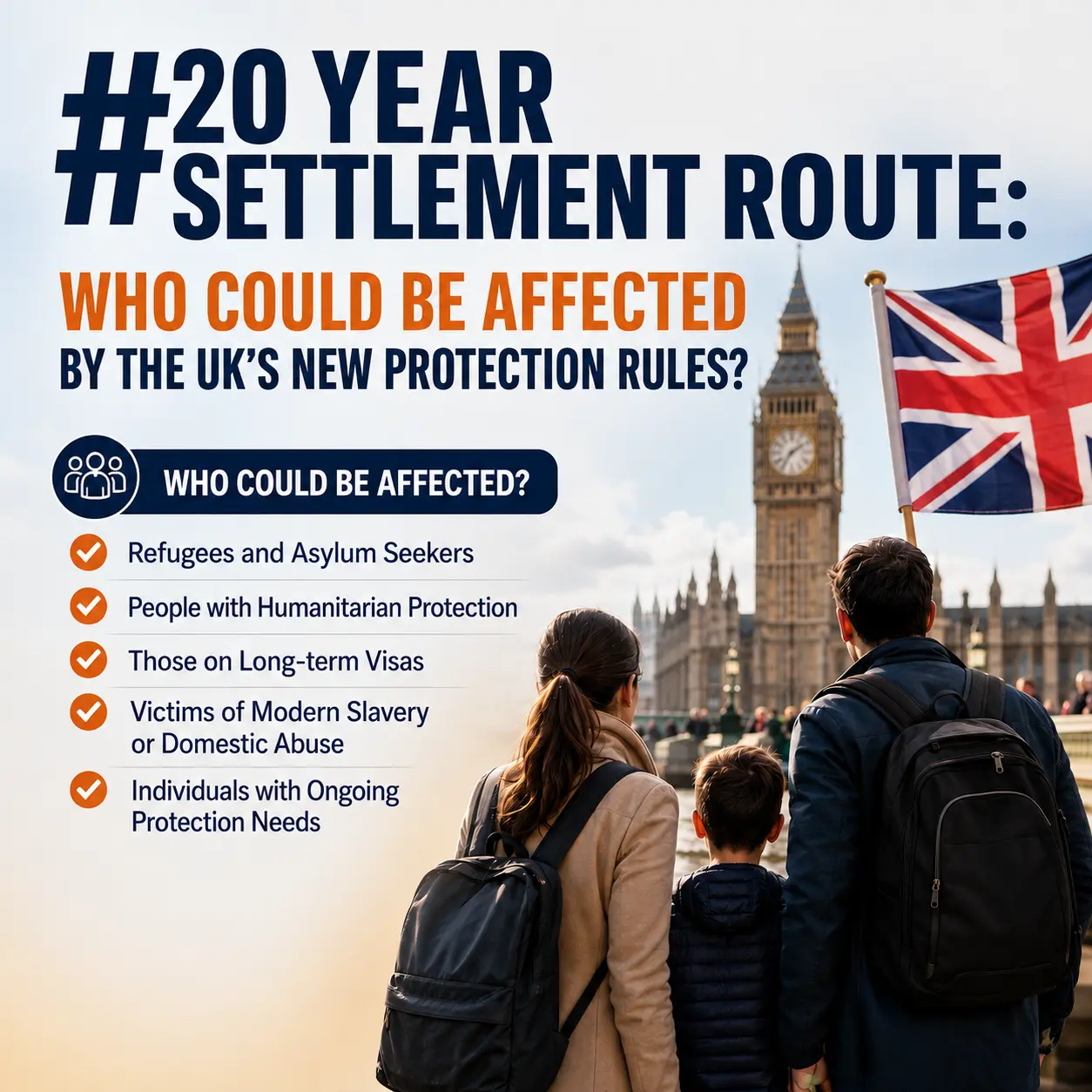
Quick answer: From 2 March 2026, people granted refugee status or humanitarian protection in the UK under the new “core protection” system must generally wait 20 years before they can apply for settlement (Indefinite Leave to Remain), instead of the previous five years. Refugees can reduce this wait by moving onto a new “work and study” route once they qualify. The change does not apply retroactively to everyone already settled or already holding pre-March 2026 refugee leave — but it affects a wide and growing group of people, and the detail matters enormously for anyone building a life in the UK.
If you or a family member hold protection status, or you’re worried about how these reforms might affect your route to settlement, Adam Bernard Solicitors’ immigration team can assess your case and map out the fastest lawful route available to you.
What Is the 20-Year Settlement Route?
The 20-year settlement route is part of the Home Office’s “core protection” model, introduced as part of the government’s wider asylum reforms announced in November 2025 and implemented from 2 March 2026. Under the old system, a person recognised as a refugee received five years’ leave to remain and could apply for Indefinite Leave to Remain (ILR) at the end of that period, without paying a fee or sitting the Life in the UK test.
Under core protection, that five-year route has effectively been replaced. Refugees are now granted an initial period of protection lasting 30 months, renewable at review if they still need sanctuary. Crucially, settlement is no longer available after five years by default — the qualifying period has been extended to a 20-year baseline, with the possibility of reducing this by switching onto an alternative “work and study” route once eligible.
This sits alongside a separate, still-evolving set of proposals under the government’s “earned settlement” consultation, which closed on 12 February 2026. Those proposals would also extend the standard 5-year settlement route to a 10-year baseline for most other visa categories, with routes of 15 or 20 years for people who have relied on public funds, and up to 30 years for those who entered the UK illegally. It’s easy to conflate the two reforms, so it’s worth being precise: the headline 20-year figure discussed most widely applies specifically to the new core protection (refugee) route, though a 20-year outcome can also arise under the broader earned settlement penalty structure once it is finalised.
Who Is Affected by the 20-Year Rule?
1. New asylum claimants from 2 March 2026
Anyone who claims asylum in the UK on or after 2 March 2026 and is granted protection falls under the core protection model. They receive 30-month renewable leave and face the 20-year route to settlement unless they move onto the work and study alternative.
2. Refugees who haven’t yet reached settlement under the old rules
Because the reforms tie into the wider “earned settlement” consultation, some refugees who were granted status before March 2026 but had not yet accrued five years’ residence may also be brought within a longer qualifying period once final rules are confirmed. This is one of the most contested and closely watched aspects of the reform, and anyone in this position should get case-specific advice rather than relying on general commentary.
3. Dependants and family members
Family reunion rights have been tightened alongside the settlement changes. There is no automatic right to bring family members to the UK under core protection. Refugees who successfully switch to the work and study route may be able to sponsor relatives, but typically only if they meet income and integration requirements similar to those applied to other visa categories.
4. People whose home country is later deemed “safe”
A defining feature of core protection is that it is explicitly temporary. At each 30-month review, the Home Office will consider whether conditions in the person’s country of origin have changed. If protection is no longer deemed necessary, the person can lose their status and become liable for removal — regardless of how long they have already spent progressing towards the 20-year mark.
5. Vulnerable applicants and children
The government has indicated it is considering further exemptions for children and other vulnerable groups, but as of publication these have not been confirmed in final Immigration Rules. Anyone relying on an expected exemption should treat it as provisional until it is formally in force.
Can Refugees Reduce the 20-Year Wait?
Yes — this is the central mechanism the government has built into the reform. Refugees who find employment or begin an appropriate level of study become eligible to move from core protection onto the new work and study route. Time spent on this route can count towards a shorter qualifying period, intended to reward economic and social integration. However, the detailed rules on exactly how much time can be “earned back,” and what evidence is required, are still being finalised through Immigration Rules changes expected later in 2026.
In practical terms, this means:
- Settlement is no longer a fixed five-year certainty for refugees.
- The route someone ends up on — and how quickly they progress — will depend heavily on individual circumstances: employment status, study, conduct, and compliance with reporting requirements.
- Early, tailored legal advice is far more valuable under this system than under the old fixed-term model, because small decisions (which route to switch to, when, and how to evidence eligibility) can materially affect the total wait.
How Does This Compare to the Standard Settlement Routes?
Route | Qualifying Period (Pre-Reform) | Qualifying Period (Under Reform Proposals) |
Refugee / core protection | 5 years | 20-year baseline, reducible via work and study route |
Standard work & family visas | 5 years | 10-year baseline proposed |
Long residence route | 10 years | Under review as part of the same consultation |
Resettled refugees (formal resettlement schemes) | 5 years | 10-year baseline proposed |
Illegal entry, including small boat arrivals | N/A | Up to 30 years proposed |
Global Talent / Innovator Founder | 3 years | Expected to remain 3 years |
These figures reflect the direction of travel set out in the government’s policy statements and the “earned settlement” consultation. Some elements, particularly around the standard work and family routes, are proposals still working through the Immigration Rules process rather than settled law, so it is important to check the current position before assuming any particular timeline applies to your case.
What Should You Do If You're Affected?
If you hold refugee status, humanitarian protection, or are currently going through the asylum process, the practical steps worth taking now are:
- Establish exactly which route you’re on. Whether you were granted status before or after 2 March 2026 significantly changes your position.
- Keep thorough evidence of employment, study, and integration. If the work and study route becomes your fastest path to settlement, documentation will matter.
- Don’t assume an exemption applies to you. Proposed carve-outs for children or vulnerable applicants are not yet confirmed in final rules.
- Get advice before your next review point. The 30-month review is a pivotal moment — decisions made there can affect your status and your family’s rights.
- Review family reunion options early, particularly if you are hoping to bring a partner or children to the UK, as the rules here have tightened considerably.
How Adam Bernard Solicitors Can Help
Immigration and asylum law is changing faster than at almost any point in the past decade, and the gap between government policy announcements and the final Immigration Rules can leave people making life-changing decisions without clear guidance. Our immigration and asylum team works with clients at every stage of the protection and settlement process — from initial asylum claims through to Indefinite Leave to Remain applications and British citizenship.
We can help you:
- Understand exactly which settlement timeline applies to your circumstances
- Build the strongest possible case for switching to the work and study route
- Prepare for 30-month protection reviews
- Advise on family reunion applications under the new rules
- Track Immigration Rules changes as they are confirmed throughout 2026, so your case strategy stays current
Contact Adam Bernard Solicitors today to arrange a consultation with our immigration team.