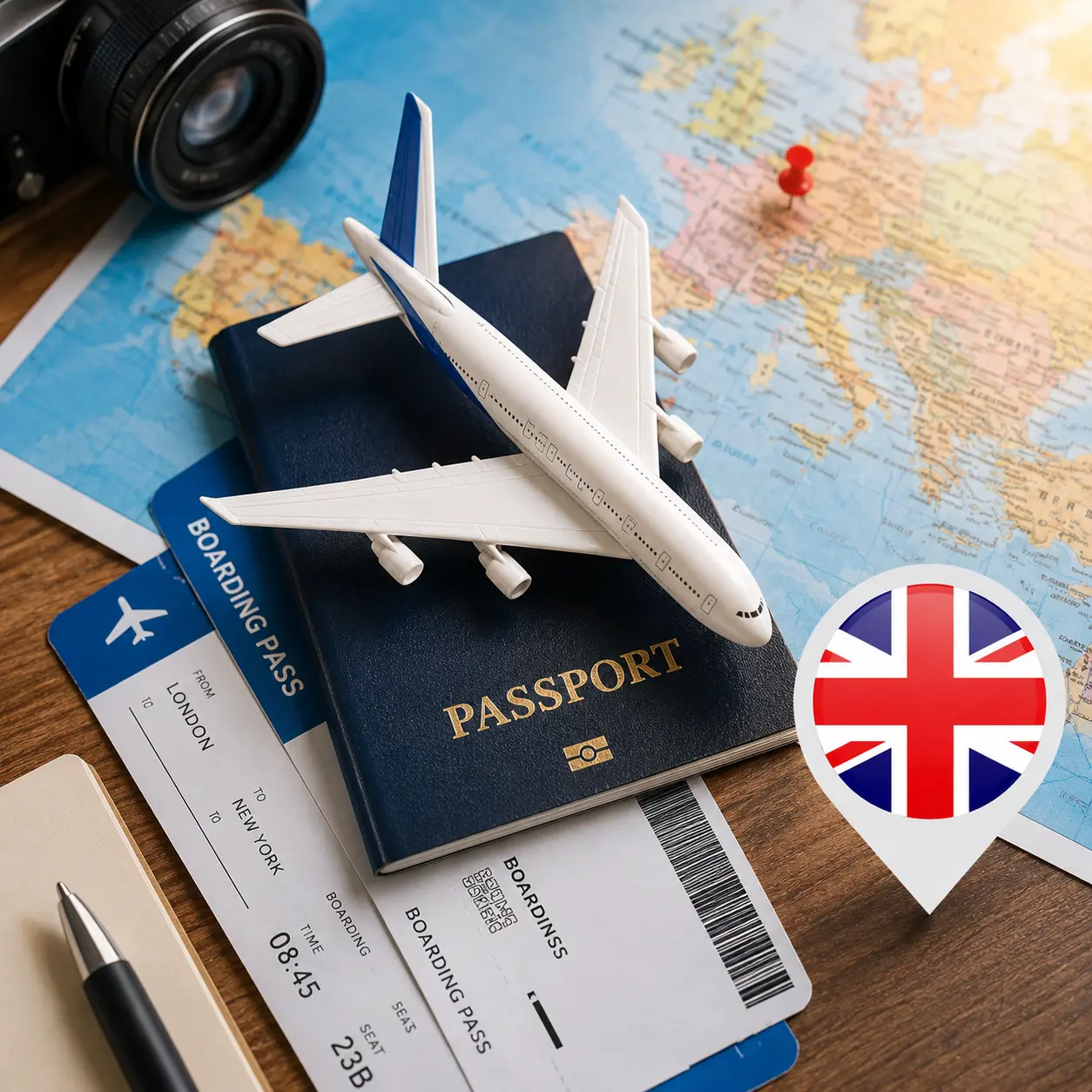
Studying in the UK puts you within easy reach of Europe and, depending on your nationality, a useful list of countries beyond it — and a valid UK Student visa can genuinely help with some of those trips. But it is worth being precise about what it actually does. Your Student visa does not function as a general-purpose travel pass. It confirms your permission to study and live in the UK; whether you can enter any other country depends on your own nationality and that country’s rules, with a limited number of destinations giving UK visa holders an easier route in. This guide sets out where a UK Student visa genuinely helps, where it makes no difference at all, and what to have in order before you book anything.
Does a UK student visa let you travel abroad?
Not on its own. Entry to any country outside the UK is governed by your passport and nationality, not by the fact that you hold a UK Student visa. What the visa does add is this: a small group of countries operate visa waiver or simplified entry schemes specifically for people who already hold a valid UK visa, on the reasoning that the UK has already vetted the traveller. These schemes are nationality-dependent, frequently revised, and usually require the UK visa to be multiple-entry and to have already been used to enter the UK at least once — a brand-new, unused visa typically will not qualify.
Because the rules shift without much notice — reports in 2025 and 2026, for example, suggested Mexico had stopped honouring UK visas for some nationalities — treat any published list, including the summary below, as a starting point for your own checks with the destination country’s embassy or official government website, not a guarantee.
Countries that offer simplified entry to UK visa holders
Region | Country |
Caucasus & Balkans | Georgia, Albania, Serbia, Montenegro, North Macedonia, Kosovo |
Middle East | UAE, Qatar, Oman, Bahrain, Saudi Arabia, Kuwait |
Caribbean & Central America | Dominican Republic, Panama, Bahamas, Jamaica and several other territories |
South-East & East Asia | Thailand, Malaysia, Singapore, Philippines |
Africa | Morocco, Kenya, Egypt |
Europe (non-Schengen) | Ireland |
This is a guide to the shape of these arrangements, not a substitute for checking current rules against your own passport before you book. Waiver schemes are reviewed regularly and can be suspended for particular nationalities without warning.
Ireland: the Common Travel Area and the British-Irish Visa Scheme
Ireland sits outside the Schengen area and is handled differently from the rest of Europe, for two separate reasons.
The Common Travel Area (CTA). The UK and Ireland allow free movement between the two countries without routine passport control. If you already hold a valid UK Student visa, you should not face immigration difficulties travelling to Ireland or back to the UK via the CTA route — but because there is no border check on that leg, your visa will not be stamped. Keep evidence of your travel dates (boarding passes, bookings) in case you need to demonstrate when you left or returned, and remember that your Student visa conditions, including work restrictions, continue to apply while you are in Ireland.
The British-Irish Visa Scheme (BIVS). This is a narrower arrangement that lets eligible travellers use a single UK or Irish visa to visit both countries. It currently applies only to Indian and Chinese nationals, and is primarily associated with short-stay UK visit visas rather than long-term routes like the Student visa. If you are an Indian or Chinese national on a Student visa and are considering using BIVS to visit Ireland, confirm your specific eligibility with the Irish immigration authorities or an immigration solicitor before relying on it — the scheme’s conditions (visa type, validity period, prior use) are strict, and getting them wrong can mean being refused entry.
Schengen area: a separate visa, based on your nationality
The Schengen area — covering most of mainland Europe, including France, Germany, Italy, Spain, the Netherlands, Portugal and Greece — is a distinct visa system that does not recognise UK Student visas at all. Whether you need a Schengen visa depends solely on your nationality. If you do, you apply through the consulate or visa application centre of the country where you’ll spend the most time (or your first point of entry, if visiting several countries), and many UK universities can issue a visa support letter confirming your student status to help with that application. Application slots can be heavily booked, particularly around university holidays, so apply well ahead — eight to twelve weeks is a reasonable margin.
Working while you travel: what your visa allows
Travel plans sometimes get tangled up with work questions, so it is worth being clear on both. On a Student visa you can generally work up to 20 hours a week during term time and full-time during official university vacation periods, provided the work is not self-employment, a business you run yourself, or a role filling a permanent full-time vacancy. This cap is a condition of your visa, not a guideline — exceeding it can put your immigration status at risk. If you take up any work, generate your eVisa share code so an employer can confirm your right to work; the same share code is useful at the UK border on your return.
How travel affects your Graduate visa and future applications
Universities have a legal duty as your Student visa sponsor to monitor your attendance and participation on your course, and to report certain events to the Home Office — including unauthorised absences serious enough to trigger withdrawal, deferrals, or early completion. If your attendance is flagged, your Student visa can be curtailed, which ends your right to remain in the UK and can affect your eligibility for the Graduate visa or later applications.
To apply for the Graduate visa, you also need to be in the UK at the time you apply. This means term-time travel should be planned around your course requirements and, where a trip falls during term, agreed with your department or personal tutor in advance rather than assumed. It is worth flagging any extended absence to your university’s international student team before you book, both to protect your attendance record and to check whether it affects a later Graduate visa or settlement application.
Before you travel: documents and checks
- A passport that is valid and correctly linked to your UK eVisa, with enough validity remaining for your destination’s requirements (some countries ask for six months beyond your travel dates)
- A current eVisa share code, generated shortly before you travel — Biometric Residence Permits (BRPs) stopped being accepted for UK re-entry after 1 June 2025, so if you are still relying on an old BRP rather than an eVisa, sort this out with UKVI first
- Your CAS number and a confirmation of enrolment or attendance letter from your university
- Evidence of your current funding and course details, in case you’re asked about your intentions at the border
- Confirmation your Student visa is multiple-entry — a single-entry visa will not readmit you to the UK after travel
- Written approval from your department if the trip falls during term time
- Travel insurance, and a copy of your documents kept separately from the originals in case your passport is lost or stolen
Common mistakes to avoid
Assuming a UK visa guarantees entry elsewhere. Waiver arrangements are limited, nationality-specific, and change without warning — Mexico is a recent example of a scheme becoming less reliable.
Relying on an unused or single-entry visa. Most simplified-entry schemes require your UK visa to be multiple-entry and to have already been used to enter the UK.
Travelling without a current eVisa share code. This can cause delays or complications re-entering the UK, particularly now BRPs are no longer valid for that purpose.
Missing university commitments without approval. Unauthorised absences during term time put both your Student visa and your Graduate route eligibility at risk.
Assuming BIVS covers you. It is limited to Indian and Chinese nationals and specific visa conditions — check before you plan a trip to Ireland around it.
Letting your passport run close to expiry. Renewals take longer when you’re abroad, and some countries require months of remaining validity.
How an immigration solicitor can help
Travel questions often sit alongside bigger ones — a visa nearing expiry, an attendance concern your university has raised, or uncertainty about how time abroad affects a future Graduate visa or settlement application. Our immigration solicitors regularly advise international students on Student and Graduate visa conditions, re-entry requirements, and what to do if a trip has affected their immigration status. If you’re unsure whether a planned trip is safe to take, it’s worth getting advice before you book rather than after a problem arises.