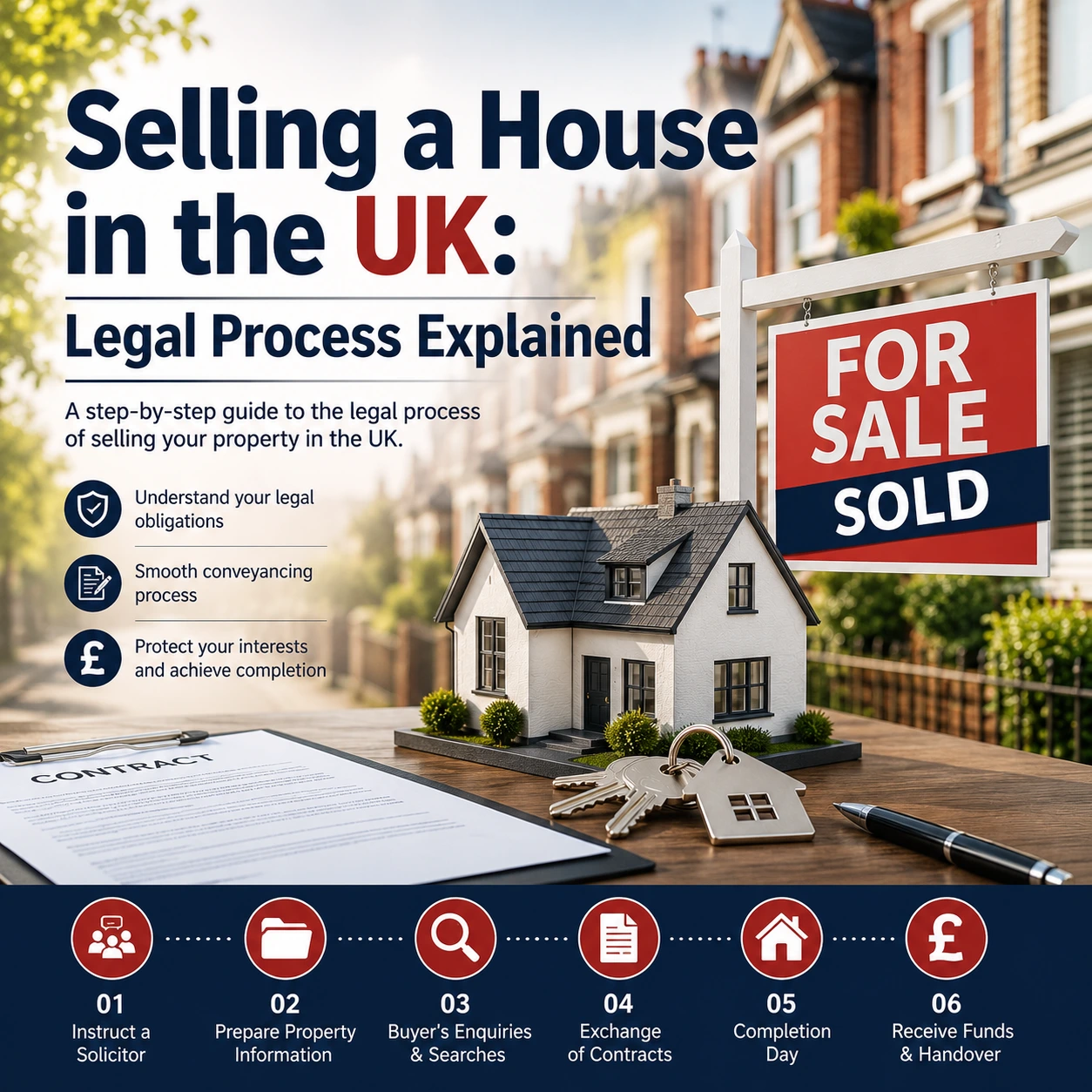
In England and Wales, the average house sale takes between 12–16 weeks, from offer acceptance to completion — but without the right legal preparation, that timeline can stretch to six months or more. In fact, the government’s own Home Buying and Selling Reform Roadmap (2026) confirms that around one in three property transactions in England and Wales fail to complete, with the average purchase now taking around 120 days from offer acceptance.
Whether you are selling a family home, a buy-to-let investment, or an inherited property, understanding what your conveyancing solicitor does at each stage of the process can prevent costly delays, protect your legal interests, and help you achieve a smooth, stress-free sale.
This guide explains the full legal process of selling a house in the UK — from instructing a solicitor to collecting your proceeds on completion day.
What Is Conveyancing When Selling a House?
Conveyancing is the legal process of transferring ownership of a property from one party to another. When you sell a property, your conveyancing solicitor acts on your behalf throughout the entire transaction — from preparing your title documents and drafting the sale contract to handling the financial transfer on completion day.
In England and Wales, conveyancing must be carried out by a qualified solicitor or licensed conveyancer. It is not something you can legally manage yourself for a mortgaged or registered property. The process involves two parallel legal tracks: your solicitor’s work on your side (the seller), and the buyer’s solicitor’s work on their side.
These two firms communicate throughout the transaction, exchanging documents, raising and responding to enquiries, and ultimately exchanging signed contracts to make the sale legally binding.
A specialist residential conveyancing solicitor does far more than fill in paperwork. They protect your legal position, identify title issues before they become problems, and keep the transaction moving when complications arise
Step 1: Instruct a Conveyancing Solicitor
One of the most important decisions you will make when selling your property is choosing the right conveyancing solicitor — and the earlier you do it, the better. Many sellers wait until an offer has been accepted before contacting a solicitor, but this approach almost always contributes to unnecessary delays.
By instructing a solicitor before your property is even listed, they can begin gathering your title documents, identifying any potential legal issues, and preparing your contract pack in advance. This means that when an offer is accepted, your solicitor is ready to proceed immediately rather than starting from scratch.
When you first instruct a solicitor, they will:
- Verify your identity in compliance with Anti-Money Laundering (AML) regulations
- Obtain official copies of your title register and title plan from HM Land Registry
- Check for any charges, restrictions, or third-party interests registered against the property
- Review the terms of your mortgage (if applicable) and contact your lender
- Prepare your initial contract pack, including the draft sale contract and property information forms
Choosing a solicitor with specific expertise in residential conveyancing — rather than a general practice firm — will typically result in faster transaction times and fewer complications.
Step 2: Gather Property Documents
Before your solicitor can prepare the contract pack, they will need a range of documents relating to the property. Gathering these early — ideally before you put the property on the market — can save several weeks during the transaction.
Documents commonly required include:
- Title deeds (if not already registered at HM Land Registry)
- Planning permission approvals for any extensions, conversions, or outbuildings
- Building regulations completion certificates for structural or electrical work
- FENSA or CERTASS certificates for windows and doors
- Boiler service records and Gas Safe certificates
- Electrical Installation Condition Reports (EICRs) where available
- Warranties and guarantees for building work, damp proofing, or roof repairs
- Leasehold documents including your lease, service charge accounts, and ground rent history (if applicable)
Missing documentation is one of the most common causes of transaction delays. If original documents have been lost, your solicitor may be able to obtain official copies or indemnity insurance to cover the gap — but this takes time. Starting the search early avoids last-minute hold-ups.
Step 3: Complete the Property Information Forms
As part of the conveyancing process, you are legally required to complete a set of standard property information forms. These forms are provided by your solicitor and form part of the contract pack sent to the buyer’s solicitor.
Property Information Form (TA6)
The TA6 is a comprehensive form that asks you to disclose detailed information about the property. It covers:
- Boundary ownership and any disputes with neighbours
- Planning permissions, building works, and alterations carried out since purchase
- Any notices received from the local authority or third parties
- Rights of way, easements, and shared access arrangements
- Utilities, drainage, and environmental matters
- Any disputes, complaints, or ongoing legal matters relating to the property
Fixtures and Fittings Form (TA10)
The TA10 sets out exactly what is included in the sale and what will be removed. This covers items such as carpets, curtains, light fittings, kitchen appliances, garden features, and fitted furniture. Disputes over fixtures and fittings are a surprisingly common source of conflict between buyers and sellers — completing this form carefully avoids misunderstandings later.
Important: You have a legal duty to answer the TA6 accurately. Providing false or misleading information could expose you to a claim for misrepresentation after completion, even if the sale has already gone through.
Step 4: Accept an Offer and Instruct Your Agent
Once a buyer makes an offer that you wish to accept, your estate agent will issue a memorandum of sale — a document confirming the agreed price, the buyer’s details, and the details of both parties’ solicitors. This formally notifies both legal teams that the transaction is proceeding.
It is important to understand that at this stage, no legal obligation exists on either side. The sale is not binding until contracts are formally exchanged. Either party can withdraw at any time before exchange without financial penalty (though this can cause significant practical and financial disruption in a chain).
Once the memorandum of sale has been issued, your solicitor will send the draft contract pack — including the TA6, TA10, and any supporting documents — to the buyer’s solicitor. The formal conveyancing process is now underway.
Step 5: Draft Contract and Pre-Contract Enquiries
After receiving your contract pack, the buyer’s solicitor will review all the documents and raise formal enquiries — written questions about the property that require answers before they can advise their client to proceed.
Common pre-contract enquiries include questions about:
- Planning history and permitted development rights
- Boundary features and ownership responsibility
- The existence of any rights of way or covenants affecting the property
- Completion of building work and compliance with building regulations
- Any known disputes with neighbours or third parties
- Status of any guarantees or indemnity insurance policies
Your solicitor will prepare responses to these enquiries on your behalf, though some questions will require you to provide direct answers. Responding promptly and thoroughly is important — delayed responses are one of the most preventable causes of transaction hold-ups.
At the same time, the buyer’s solicitor will order local authority searches, drainage searches, and environmental searches. These are carried out by the local council and third-party providers and can take between one and four weeks depending on the area.
Step 6: Mortgage Redemption and Title Confirmation
If you have an outstanding mortgage on the property, your solicitor will contact your lender early in the process to request a redemption statement — a figure confirming exactly how much you owe, including any early repayment charges.
This figure is important for two reasons: it tells you what you will receive net of mortgage repayment on completion day, and it allows your solicitor to make arrangements to repay the lender directly from the sale proceeds.
Your solicitor will also confirm that you have good and marketable title to the property — meaning you have the legal right to sell it and that there are no undisclosed claims or interests that could affect the buyer’s ownership. If any issues are identified on the title register (such as outdated restrictions, missing consents, or unregistered rights), your solicitor will take steps to resolve them before exchange.
Step 7: Exchange of Contracts
Exchange of contracts is the single most important milestone in the property sale process. It is the point at which the transaction becomes legally binding for both parties.
Before exchange can take place, the following must be in order:
All enquiries have been satisfactorily answered
The buyer’s mortgage offer has been formally issued
All parties in the chain have confirmed they are ready to exchange
A completion date has been agreed
Both solicitors have signed copies of the contract
At the moment of exchange, both solicitors exchange signed contracts — historically over the telephone using a formal Law Society procedure, though increasingly handled electronically. The buyer pays a deposit (typically 10% of the purchase price) to their solicitor, which is then held until completion.
Once contracts have been exchanged, neither party can withdraw without serious legal and financial consequences. If the buyer pulls out after exchange, they forfeit their deposit. If you as the seller pull out after exchange, you may face a claim for damages from the buyer.
Exchange is the finish line most buyers and sellers work towards. After this point, your completion date is fixed and both parties are committed. The sense of security this provides is significant — particularly in a chain.
Step 8: Completion Day
Completion day is the day legal ownership of the property transfers to the buyer. It is typically set between one and four weeks after exchange of contracts, though same-day exchange and completion is possible in some circumstances.
On completion day, the following sequence of events takes place:
- The buyer’s solicitor transfers the full purchase funds to your solicitor by electronic bank transfer
- Your solicitor confirms receipt of funds and notifies you
- Your solicitor repays your outstanding mortgage in full from the sale proceeds
- Estate agent fees and any other agreed deductions are settled
- Your solicitor transfers the remaining balance — your net sale proceeds — to your nominated bank account
- Your estate agent releases the keys to the buyer
Once funds have been confirmed received, the property legally belongs to the buyer. You must vacate the property before the agreed completion time — typically 12 noon to 2pm, though this can vary by agreement.
After completion, your solicitor notifies HM Land Registry, which updates the title register to reflect the change of ownership. Your solicitor’s file is then closed.
Selling a Leasehold Property: Additional Considerations
If you are selling a leasehold flat or house, the conveyancing process involves additional legal work that does not apply to freehold transactions. This is primarily because a third party — the freeholder or management company — is involved and must supply information to the buyer’s solicitor.
Your solicitor will need to obtain a leasehold management information pack (also known as a LPE1 pack), which typically includes:
- Details of the current ground rent and any review schedule
- Service charge accounts for the past three years
- Building insurance policy details
- Management company accounts and company information
- Details of any major works planned or recently completed
- Confirmation of any outstanding service charge arrears on the property
Obtaining this pack from a freeholder or managing agent can take anywhere from two to six weeks, and many agents charge fees of £150–£400 for providing it. This is one of the main reasons leasehold transactions consistently take longer than freehold sales.
Short Leases and Lease Extensions
If your lease has fewer than 80 years remaining, this can significantly affect the buyer’s ability to obtain a mortgage — most mortgage lenders require at least 70 to 85 years on the lease at the time of completion. A short lease may reduce your pool of potential buyers and affect the achievable sale price.
If your lease is approaching this threshold, it is worth taking legal advice about a lease extension before marketing the property. Your solicitor can advise on your rights under the Leasehold Reform, Housing and Urban Development Act 1993.
How Long Does the Legal Process Take When Selling a House?
The table below sets out typical timescales from offer acceptance to completion. These are averages — individual transactions can be faster or slower depending on the factors listed.
Property Type | Typical Timescale | Key Variables |
Freehold property | 8–12 weeks | Mortgage, searches, chain length |
Leasehold flat or house | 10–16 weeks | Management pack, lease queries |
Inherited or probate property | 12–20 weeks | Grant of representation required |
New build (buyer) | Variable | Developer completion schedule |
The most significant factor affecting timescale is the length and complexity of the property chain. A chain of four or five properties all depending on each other’s transactions simultaneously is far more susceptible to delay than a straightforward chain-free sale to a cash buyer.
How Much Does It Cost to Sell a House in the UK?
The table below summarises the typical costs associated with selling a residential property in England and Wales. These are estimates — actual costs will vary depending on your property, location, and the professionals involved.
Cost | Typical Range | Notes |
Conveyancing solicitor fees | £800 – £1,800 | Fixed-fee quotes available |
Estate agent commission | 1% – 3% + VAT | Varies by agent and agreement |
Mortgage redemption fee | £50 – £300 | Charged by your lender on repayment |
EPC (Energy Performance Certificate) | £60 – £120 | Required by law before marketing |
Leasehold management pack | £150 – £400 | Charged by freeholder or managing agent |
Capital Gains Tax (if applicable) | 18% or 24% | Applies to second homes and buy-to-let |
At Adam Bernard Solicitors, we offer conveyancing quotes so you know exactly what your legal costs will be before you commit. There are no hidden charges and no unexpected additions at the end of the process.
Disclaimer: This content is for general information purposes only and does not constitute legal advice. For advice on your specific situation, please contact Adam Bernard Solicitors directly.
Why Choose Adam Bernard Solicitors for Your Property Sale?
Our residential conveyancing team has extensive experience handling property sales across London and the UK. We provide practical, transparent legal advice at every stage of the process — keeping you informed, protecting your interests, and working proactively to keep your transaction on track.
We handle sales of freehold and leasehold properties, buy-to-let investments, inherited properties, and Help to Buy transactions. Our offices in Central London (High Holborn) and East London (Upton Park) mean we are conveniently located for clients across the capital.