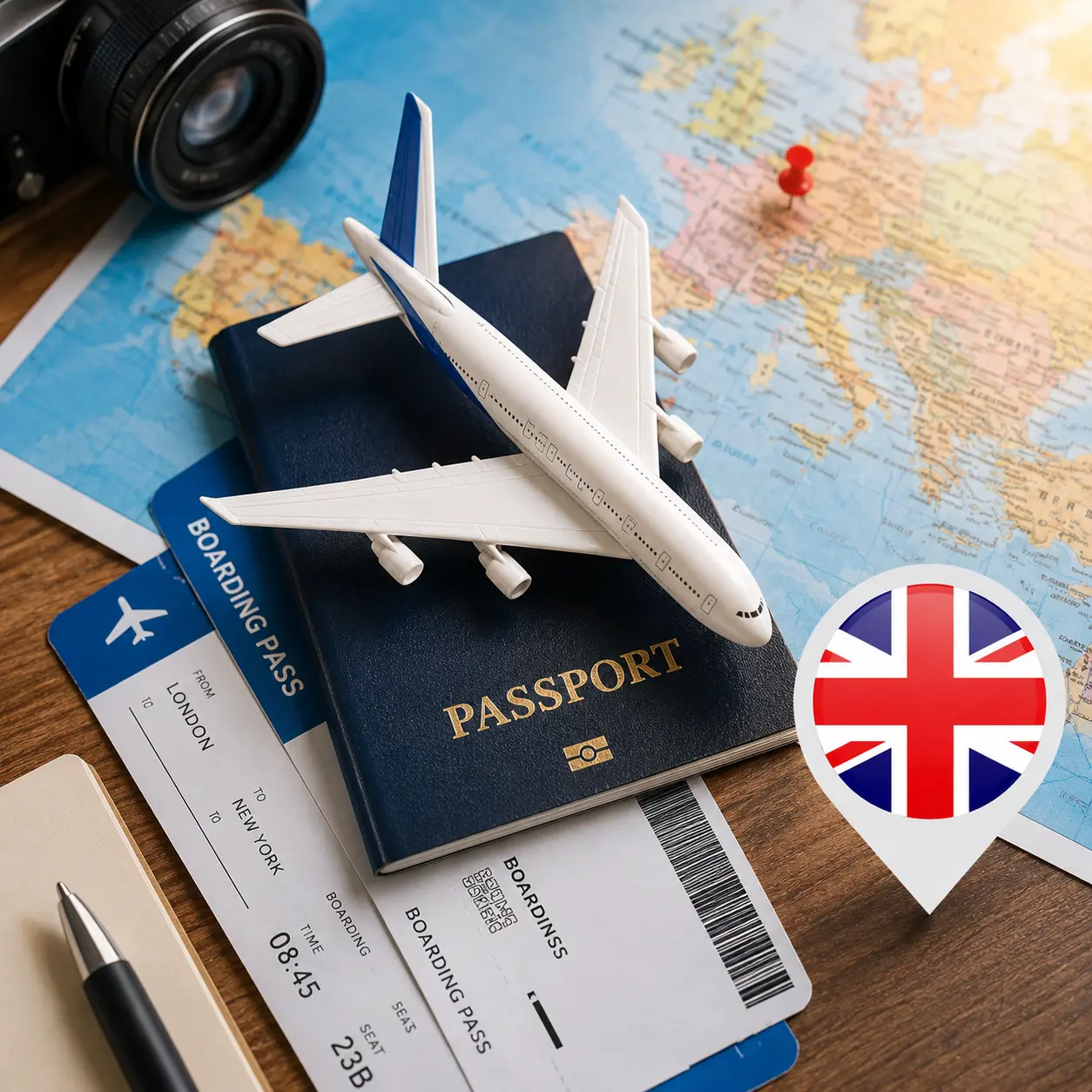
If you have been granted refugee status in the UK and need to travel internationally, you cannot simply apply for a British passport. Instead, you will need a UK Refugee Travel Document — also known as a 1951 Convention Travel Document or Geneva Passport — issued by the Home Office.
This guide explains everything you need to know about the UK Refugee Travel Document in 2026: who qualifies, how to apply, what documents you need, current fees, how long it takes, and when to renew. If you hold a Refugee Travel Document and want to know where you can travel, read our companion guide: Visa-Free Countries for UK Refugee Travel Document Holders in 2026.
Quick Facts: UK Refugee Travel Document 2026 | |
Also known as | 1951 Convention Travel Document / Geneva Passport |
Issued by | UK Home Office (UKVI) |
Who qualifies | Refugees granted asylum in the UK; family reunion visa holders |
Fee (adults) | £102 |
Fee (children under 15) | £66.50 |
Validity (ILR holders) | Up to 10 years |
Validity (limited leave) | Until end of your leave, up to 5 years |
Apply online | Yes — via GOV.UK |
Must apply from | Inside the UK |
What Is a UK Refugee Travel Document?
A UK Refugee Travel Document is an official travel document issued by the Home Office to individuals who have been granted refugee status in the United Kingdom. It looks similar to a blue booklet and serves the same purpose as a passport — allowing you to travel internationally and return to the UK — but it is not a British passport.
The document is issued under the 1951 United Nations Convention Relating to the Status of Refugees (the Refugee Convention), which is why it is sometimes called a 1951 Convention Travel Document. Some people also call it a Geneva Passport, though this is an informal term.
There are four types of Home Office travel documents. It is important to apply for the correct one:
- Refugee Travel Document — for people granted refugee status (blue booklet)
- Stateless Person’s Travel Document — for people recognised as stateless in the UK
- Certificate of Travel — for people with humanitarian protection or other leave who cannot get a national passport
- One-Way Travel Document — for those leaving the UK permanently with no right to return
This guide focuses on the Refugee Travel Document. If you have humanitarian protection rather than refugee status, you will need to apply for a Certificate of Travel instead.
Who Can Apply for a UK Refugee Travel Document?
You can apply for a UK Refugee Travel Document if you meet one of the following criteria:
- You have been granted leave to remain in the UK as a refugee (asylum has been granted), or
- You came to the UK on a Family Reunion visa to join someone who holds refugee status in the UK
You must also meet all of the following conditions:
- You are physically inside the UK at the time of application
- You have at least six months of valid permission to remain in the UK, unless you hold Indefinite Leave to Remain (ILR)
- You are unable to obtain a national passport from your country of origin
Important — new rule from March 2026: If you claimed asylum on or after 2 March 2026, the Home Office will now grant 30 months of refugee status initially (reduced from the previous 5-year grant). This means many refugees will need to renew their refugee status and travel document more frequently before reaching the point where they can apply for settlement.
How to Apply for a UK Refugee Travel Document in 2026
The Home Office now processes most Refugee Travel Document applications online. Here is a step-by-step breakdown of the process.
Step 1: Check You Are Eligible
Before starting your application, confirm that you hold refugee status or a Family Reunion visa, that you have at least six months of permission to remain, and that you are currently inside the UK. If your leave expires in less than six months, you should apply to extend your stay before applying for the travel document.
Step 2: Gather Your Documents
You will typically need the following:
- Your Biometric Residence Permit (BRP) details or eVisa share code
- Your current passport or other identity document (if you have one)
- Your decision letter from the Home Office confirming refugee status
- Two recent passport-sized photographs (electronic format now required — you can obtain these from a photo booth that provides a digital version)
- Details of any previous Home Office travel documents
- Names and dates of birth of any dependants being included (note: each child requires a separate application)
Step 3: Complete the Online Application
Go to GOV.UK and search for “Apply for a Home Office travel document.” Select “Refugee travel document” from the options. The online form will guide you through your personal details, immigration status, and reason for applying. Take care to answer all questions accurately — mistakes at this stage are one of the most common causes of delays and refusals.
Step 4: Pay the Application Fee
Current fees as of April 2026:
- Adults (aged 16 and over): £102
- Children (aged 15 and under): £66.50
Fees are paid online as part of the application. Note that fees are non-refundable, even if your application is refused. If you are applying for multiple family members, each person pays separately.
Step 5: Submit Documents
Depending on the online form’s instructions, you will either upload your supporting documents digitally or send originals by post to the address shown at the end of the form. If posting, always send original documents (not photocopies), keep copies for yourself, and use a tracked postal service. Do not send documents that are not requested.
Step 6: Biometrics Appointment (if required)
Some applicants will be asked to provide biometrics (photograph and fingerprints) at a designated centre. If this applies to you, the Home Office will send instructions on how to book your appointment after you submit your application.
Step 7: Wait for a Decision
Processing times are not guaranteed and vary significantly depending on application volume and complexity. In practice, applications typically take several weeks to a few months. Apply well in advance of any planned travel — the Home Office does not prioritise applications due to upcoming trips.
How to Renew a UK Refugee Travel Document
Renewing a Refugee Travel Document follows the same process as a first application — you apply through GOV.UK, pay the same fee, and submit the same categories of supporting documents.
When Should You Renew?
You should apply to renew your travel document in the following situations:
- Your document is approaching its expiry date. Apply at least three months before expiry, especially if you travel frequently.
- You have renewed your leave to remain and the validity on your travel document no longer matches.
- You have been granted ILR (Indefinite Leave to Remain) and your previous document was issued for a shorter period.
- Your document has been lost, stolen, or damaged (a replacement requires a new application and a new fee).
Validity Periods
- Adults with ILR: up to 10 years
- Adults with limited leave to remain: valid until the end of your leave, up to a maximum of 5 years
- Children (under 15) with ILR: up to 5 years
- Children with limited leave to remain: valid until the end of their leave, up to 5 years
Because the document is tied to your leave to remain, if your leave is only 30 months (as is now standard for new grants from March 2026), your travel document will also be valid for approximately 30 months. You will need to renew both when you extend your status.
Important Rules When Using a Refugee Travel Document
Before travelling on your Refugee Travel Document, there are several rules you must understand:
You Cannot Travel to Your Country of Origin
This is the most critical rule. You must never use your Refugee Travel Document to travel to the country from which you fled or sought asylum. Doing so can be treated as evidence that you no longer need international protection, and the Home Office may use it to revoke your refugee status. There are only extremely narrow exceptions to this rule, and they require explicit prior authorisation.
You May Still Need a Visa
A Refugee Travel Document is not as widely accepted as a British passport. Many countries that are visa-free for British passport holders will still require a visa if you are travelling on a Refugee Travel Document. Always check the entry requirements of your destination country in advance. Our guide to visa-free countries for UK Refugee Travel Document holders covers the destinations where you can travel without a separate visa.
Carry Your BRP or eVisa Proof
When travelling internationally, always carry your Refugee Travel Document alongside your BRP or eVisa share code. Some border officers and airline staff may be unfamiliar with Refugee Travel Documents, and having your eVisa share code as backup evidence of your UK immigration status can prevent delays.
Report Loss or Theft Immediately
If your travel document is lost or stolen, report it to the Home Office immediately. If it was stolen, you must also report it to the police and obtain a crime reference number. A replacement requires a full new application, including the fee. You must be inside the UK to apply for a replacement.
Disclaimer: This content is for general information purposes only and does not constitute legal advice. For advice on your specific situation, please contact Adam Bernard Solicitors directly.