What is a civil partnership visa in the UK?
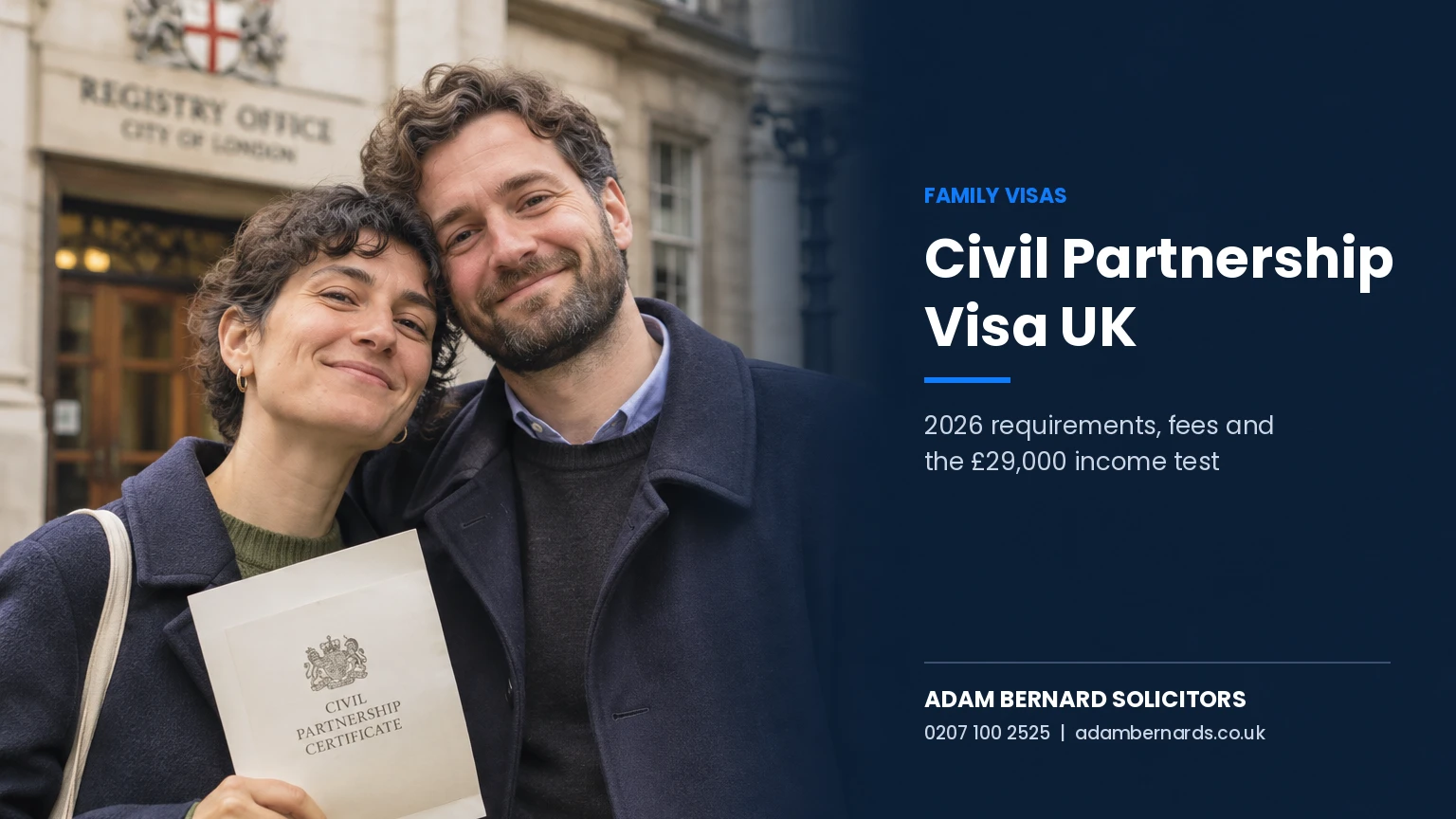
A civil partnership visa is the UK family visa for someone in a civil partnership (or planning one) with a British or Irish citizen or a person settled in the UK. It is not a separate visa: civil partners apply on the same partner route as spouses, under Appendix FM of the Immigration Rules.
It is open to same-sex and opposite-sex couples. You will usually need a combined income of at least £29,000, English at level A1, and suitable accommodation. A successful applicant from outside the UK gets 2 years and 9 months, then extends, and can usually apply to settle after 5 years.
This guide explains each requirement, the 2026 Home Office fees, processing times, and what to do if you are refused. All figures are taken from GOV.UK and were checked on 11 November 2026.
Which civil partnership visa route applies to you?
Which route you use depends on whether your civil partnership already exists. The Immigration Rules define a “partner” as a spouse, civil partner, fiancé(e) or proposed civil partner, or an unmarried partner of at least 2 years (Appendix FM, GEN.1.2).
| Your situation | Route | Initial grant | Can you work? |
|---|---|---|---|
| Already in a civil partnership recognised in the UK | Partner visa as a civil partner | 2 years 9 months (outside UK) | Yes |
| Planning to register a civil partnership in the UK | Proposed civil partner visa | 6 months | No |
| Together 2+ years but not in a civil partnership | Unmarried partner visa | 2 years 9 months (outside UK) | Yes |
Proposed civil partner visa
If you plan to register your civil partnership in the UK, you apply as a proposed civil partner. You must register within 6 months of arriving, and any earlier marriage or civil partnership must have ended. You cannot work or study during those 6 months. Once registered, you apply from inside the UK to switch to the full partner visa (GOV.UK).
Time spent as a proposed civil partner does not count towards the 5 years needed to settle.
Civil partnerships registered abroad
A civil partnership registered overseas can be used if it is recognised in the UK. The Home Office checks that it is valid when you first apply as that person’s partner. If you are unsure whether yours is recognised, take advice before applying.
Civil partnership visa requirements
To qualify, you must meet five main requirements: your partner’s status, your relationship, the financial test, English language and accommodation.
1. Your partner’s status
Your civil partner must be 18 or over and one of the following (GOV.UK):
- a British or Irish citizen
- settled in the UK (for example, with indefinite leave to remain)
- holding pre-settled status under the EU Settlement Scheme, having started living in the UK before 1 January 2021
- in the UK with protection status, a Turkish Businessperson or Worker visa, or permission as a stateless person
2. Your relationship
You must both be 18 or over, have met in person, and be in a genuine and subsisting relationship. You must not be too closely related, and any previous marriage or civil partnership must have broken down permanently. You must intend to live together permanently in the UK (Appendix FM).
3. The financial requirement (£29,000)
If you first apply on or after 11 April 2024, you and your partner need a combined income of at least £29,000 a year. Couples who first applied before that date stay on the old £18,600 threshold when extending or settling with the same partner (GOV.UK).
If you are applying from outside the UK, only your partner’s UK income usually counts, plus any cash savings. Savings above £16,000 can make up a shortfall in income.
4. English language
You must pass an approved English test in speaking and listening at level A1 or above for your first application. When you extend after 2.5 years, you need level A2 (GOV.UK). You are exempt if you are 65 or over, have a disability that prevents you from taking the test, or are a national of a majority English-speaking country.
5. Accommodation
You must have adequate accommodation for you and any dependants, without using public funds. It does not have to be owned. A rented home or living with family can work, provided it is not overcrowded.
Documents you need for a civil partnership visa
Most refusals come down to missing or weak evidence, so build your document bundle carefully. Relationship evidence should come from an official source, such as a government body, bank, landlord, utility provider or medical professional, and be less than 4 years old (GOV.UK).
- Identity: a valid passport for you, and proof of your partner’s British citizenship or settled status
- Civil partnership: your civil partnership certificate (or, for proposed civil partners, evidence of your plans, such as a booking with a register office)
- Previous relationships: a divorce or dissolution certificate for any earlier marriage or civil partnership (GOV.UK)
- Relationship evidence: joint tenancy or council tax bills, joint bank statements, photos together, travel records and messages over time
- Finances: payslips, bank statements and an employer letter that match the specified evidence rules
- English: an approved test certificate at A1 or above, or proof of exemption
- Accommodation: a tenancy agreement or title deeds, plus a letter from the owner if you live with family
- Tuberculosis test: if you are applying from a country where TB testing is required
Civil partnership visa fees in 2026
From 8 April 2026, the visa fee is £2,064 from outside the UK and £1,407 from inside the UK, plus the Immigration Health Surcharge of £1,035 per year. Proposed civil partners pay the same £2,064 visa fee (Home Office fees, 8 April 2026; GOV.UK family visa fees).
| Cost | Outside the UK (2 years 9 months) | Inside the UK (2 years 6 months) |
|---|---|---|
| Visa application fee | £2,064 | £1,407 |
| Immigration Health Surcharge | £3,105 | £2,587.50 |
| Total per adult | £5,169 | £3,994.50 |
| Optional priority service | £500 | Check availability when applying |
| Optional super priority service | £1,000 | Check availability when applying |
The surcharge is charged for each year of your visa. A part year over 6 months counts as a full year, and 6 months or less counts as half a year (GOV.UK IHS). Proposed civil partners applying from outside the UK for 6 months do not pay the surcharge.
These are Home Office charges only. Legal fees and English test costs are extra.
How long does a civil partnership visa take?
From outside the UK, you will usually get a decision within 12 weeks. From inside the UK it is usually 8 weeks, but about 12 months if you do not meet the financial and English requirements (GOV.UK). You may be able to pay for a faster decision.
How to apply for a civil partnership visa
- Check you qualify. Confirm your partner’s status, your relationship evidence, the £29,000 test and your English.
- Gather your documents. Use the checklist above, and make sure the financial evidence covers the right period.
- Apply online. Complete the form on GOV.UK and pay the visa fee and health surcharge.
- Prove your identity. Attend a visa application centre for biometrics, or use the ID check app where you are eligible.
- Wait for the decision. You will receive an eVisa linked to your UKVI account if you are successful.
- Extend before your visa expires. After 2 years 9 months, apply for a further 2 years 6 months, this time with English at A2.
Civil partnership visa vs spouse visa
There is no legal difference: civil partners and spouses apply on the same partner route, with the same fees, income test and settlement rules. The only differences are the certificate you provide and, for unregistered couples, the choice between the fiancé(e) and proposed civil partner routes.
| Civil partner | Spouse | Unmarried partner | |
|---|---|---|---|
| Proof of relationship | Civil partnership certificate | Marriage certificate | 2 years in a relationship similar to marriage or civil partnership |
| Income requirement | £29,000 | £29,000 | £29,000 |
| First grant (outside UK) | 2 years 9 months | 2 years 9 months | 2 years 9 months |
| Settlement (ILR) | After 5 years | After 5 years | After 5 years |
From civil partnership visa to indefinite leave to remain
The earliest you can apply to settle is after 5 continuous years in the UK on a family visa as a partner. Time on any other visa, or as a proposed civil partner, does not count (GOV.UK). You will also need to meet the English language and Life in the UK requirements when you apply (GOV.UK ILR).
Settlement rules are changing, so check the current requirements before you apply. Our Settlement / Indefinite Leave to Remain team can confirm what applies to you.
Common reasons civil partnership visas are refused
Most refusals relate to finances, relationship evidence or paperwork, not eligibility itself.
- Income evidence that does not cover the required period or does not match the specified evidence rules
- Too little evidence that the relationship is genuine and subsisting
- No proof that a previous marriage or civil partnership has ended
- An English test from a provider that is not approved, or at the wrong level
- Accommodation that would be overcrowded
A refused partner visa often carries a right of appeal as a human rights claim. Depending on the decision, you may instead need an administrative review or a fresh application. See our Immigration Appeals and Administrative Review pages.
How Adam Bernard Solicitors can help
Our SRA-regulated immigration solicitors in London help couples through the full partner visa process. We check your eligibility, review your financial evidence against the rules, prepare your relationship bundle and submit the application. If you have been refused, we can advise on an appeal or a new application.
We work with clients from our High Holborn and Upton Park offices, and by video call on Zoom, Teams, WhatsApp or Skype.
Call 0207 100 2525 (24/7) or book an appointment to speak to a civil partnership visa solicitor.
Related: Spouse / Partner Visa · Family Visa Application · Marriage Visitor Visa · Spouse Visa Extension